Die with Zero Review: Why I Don't Buy Bill Perkins' Bestseller

A few weeks ago, a post on X mentioned a book called Die with Zero. Small book, interesting premise, high ratings. I opened Audible, set it to 2x, and by the time my commute and a couple of morning walks were done, so was the book. Two hours, cover to cover.
That should tell you something before I do.
A "revolutionary approach to maximizing life experiences," according to the cover. Two hours at double speed is not how you absorb a revolution. It's how you skim a blog post that got a book deal.
What the Book Actually Argues
Perkins' idea, stripped of the framework names: don't die with money you never used. Spend it on experiences while you're young enough to enjoy them, because a rupee spent at seventy buys less life than the same rupee spent at thirty. He calls this "net fulfillment over net worth," and builds a set of tools around it — time buckets for different life stages, a "personal interest rate" for deciding whether to spend now or later, and "memory dividends," the idea that an experience keeps paying you back every time you remember it.
The core instruction is simple: work less, spend more, don't wait for a retirement you might not live to enjoy. Perkins sums up his own worldview in six words: "What Good Is Wealth Without Health?" Fair question. It's the answer that gets complicated.
My Die with Zero Review: Why It Doesn't Hold Up
You can't plan for a date you don't know
The entire framework rests on knowing, roughly, when you'll die. Perkins asks you to draw a "net worth curve" that hits zero at your last year. But nobody has that number. You could plan a spend-down starting at sixty and live, healthy, to ninety-five. Or you could plan generously for a long life and be gone at fifty-eight. The book gestures at this with actuarial tables and insurance products for the downside, but never gets concrete. There's no real answer for what happens if you spend down too early and the money runs out at seventy-eight instead of running out when you do. "Plan your spending around your death" sounds precise. It isn't. It's a guess wearing a spreadsheet.
Whose advice is this?
Perkins didn't get rich from following this book. He wrote it after he was already a hedge fund manager worth hundreds of millions, one of the most successful energy traders on Wall Street. That matters, because the book asks you to take real risks — spend more now, work less, trust that it'll work out — and the man giving that advice was never one bad year away from anything. Advice is easy to give from a safety net you didn't mention you're standing on.
And here's the part that should have been his best idea, except it isn't new: instead of leaving money to your kids after you die, give it to them while you're alive — help with college, a wedding, a down payment. Perkins presents this as insight. In most Indian households, it's just Tuesday. Parents have been funding their children's education, weddings, and first homes while very much alive, for generations, without a hedge fund manager's permission or a "personal interest rate" to justify it. The one part of this book that isn't obvious in hindsight is also the one part that isn't original.
"Enjoy now" is not a plan, it's a mood
The instruction to spend more and work less sounds liberating until you ask the only question that matters: how much? Perkins doesn't give you a number, because there isn't one. Spend too little and you're back to the over-saving he criticizes. Spend too much and you've traded a comfortable seventy for a broke eighty. The book treats this as a dial you can simply turn toward "more experiences," when in practice it's a decision made under total uncertainty, with real consequences on both sides.
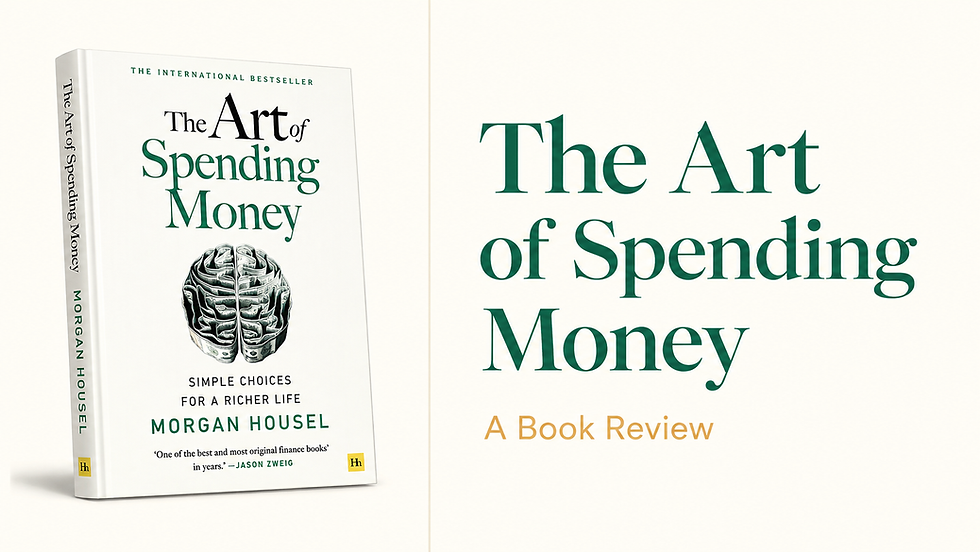
What actually buys peace isn't a formula for optimal spending. It's having enough — a subject I went deeper into in my review of Morgan Housel's The Art of Spending Money — enough that you stop running the numbers every month, enough that a bad year doesn't threaten anything. That's a different, quieter goal than the one this book is selling, and it doesn't need two hundred and fifty pages to explain.
So What
So skip the two hours, save the credit. If you want the one real idea in Die with Zero, here it is, free: don't wait until you're seventy to help the people you love or do the things you want to do, if you can help it today. You didn't need a book for that. You needed to be told to stop waiting.
The rest — the curves, the buckets, the personal interest rate — is a wealthy man's spreadsheet dressed up as a philosophy. It works fine if you already have his safety net. For most people spending real, finite, non-hedge-fund money, the harder and more honest question isn't "how do I die with zero." It's "how much is actually enough." That book hasn't been written with a catchy enough title yet.
Happy Reading! Further Reading
If this review made you curious rather than convinced, these go further — some agree with Perkins, some argue back, one got there decades earlier.
Die Broke by Stephen M. Pollan and Mark Levine
The 1997 original. Same "spend it while you're alive, give to your kids now, not later" argument — including the exact same line about a $10,000 gift meaning more to a 25-year-old than an inheritance decades later. Read this to see that Perkins didn't invent the idea, he repackaged it. Get your copy
Enough: True Measures of Money, Business, and Life by John C. Bogle
Bogle's answer to "how much is enough" — the quieter, more disciplined counter-argument to "spend it all." Get your copy
The Psychology of Money by Morgan Housel
Housel's first book, on earning and holding money wisely — the natural prequel to spending it wisely. Get your copy
The Art of Spending Money by Morgan Housel
My own review is linked above. Read it as the more thoughtful version of what Perkins is trying to say. Get your copy
Your Money or Your Life by Vicki Robin and Joe Dominguez
Reframes money as life energy traded for time — a more rigorous version of Perkins' "energy" language, written decades before him. Get your copy
The Little Book of Common Sense Investing by John C. Bogle
Not about spending at all — about why you shouldn't be trying to outsmart the market with a "personal interest rate" formula in the first place. Get your copy
Comments