The Art of Spending Money Review: What Morgan Housel Gets Right and Wrong
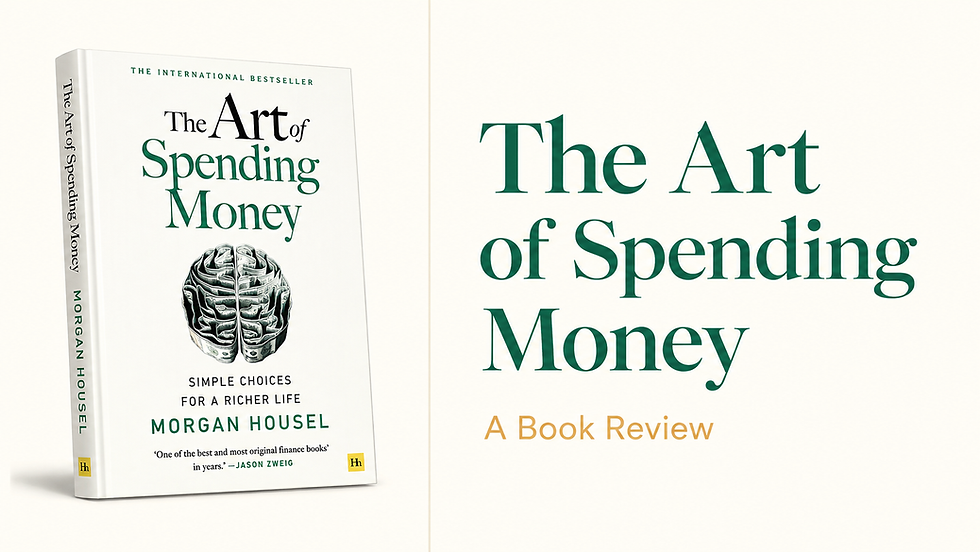
The Art of Spending Money Review: A Reader's Honest Take
Morgan Housel wrote The Psychology of Money in 2020. It has sold over 10 million copies. That book was about earning, saving and investing. This book is about "what to do with the money you have — once you have it." Very few books teach this part.
The argument is simple. Most of us learn how to make money. Almost none of us learn how to spend it. So we spend it badly. We buy things to impress people we do not even like. We upgrade our lives faster than our income grows. We end up working for the money instead of the money working for us.
Housel's sharpest line in the whole book is this one:
Wealth without independence is a unique form of poverty.
I picked up the book because I have read almost everything Housel has published, and I wanted to know if he had anything new to say. Also because the title is honest. Most personal finance books are about getting rich. Very few are about what happens next.
The book is good. It is also longer than it needs to be. More on that later.
But first, some context on why I read this book differently from most people who pick it up.
I was born in a small hamlet in a remote corner of Gujarat. About a hundred houses. A seasonal river. Groundwater that sat low even in a good year. Red soil. My grandparents farmed about ten acres of it, growing groundnut, and the house we lived in was built from mud, straw and cow dung.
No lamp. No fan. No running water. No toilet.
One bad crop and the family was in debt. A wedding, an illness, anything unplanned, and the family was in debt. This was not a bad year. This was most years.
My father studied. He became a teacher. That one decision is the reason my family's story does not end where it started.
From there we moved. Below poverty, to poverty, to lower middle class, to middle class. Today, upper middle class. My family has stood on every rung of that ladder, one generation at a time.
So if anyone is allowed an opinion on what money is actually worth, it is people like us.
Money started to matter less once I passed out of IIMB and started earning. Not because money stopped mattering. Because the problems it was solving started disappearing one by one.
Once a proper salary started coming in, the basics started getting covered. Rent. Transport. Medicine. Education. A little recreation. None of it was grand. But things I had never seen in my life, I started to get.
I remember the first time I took my parents to a five star hotel - after I got a job. A vegetarian one — yes, we have pure vegetarian five star hotels in Gujarat. I remember the pride on their faces walking in, and I remember it was still there when we walked out after dinner. I do not know how long a memory like that stays with a person. I am sure it stays a long time.
Then the first flight. Both of them, in their sixties. This was 2008, when airlines still served you food and water without asking twice, and the cabin crew treated you like a guest rather than a passenger checking in for a budget fare. My parents noticed all of it. My father had spent his whole life on state transport buses.
This is the part of the book Housel gets right. Money is not the finish line. It is the thing that removes obstacles between you and the people you love.
But here is what I want to say clearly, because the book spends 250 pages saying it in a roundabout way. None of the important things changed.
We were poor and we ate two meals together, every day, as a family. We are upper middle class now and we still eat two meals together, every day, as a family. We were poor and I had a close circle of friends I would play with until the streetlights came on. Most of those particular friends are still back in the town I grew up in. But the friendship itself, as a feeling, never went away. It just found new people to attach itself to — school, college, work. The circle grew. It never emptied out. We watched movies together as a family when we could not afford much else. We still do.
Money did not build any of that. Money just meant we no longer had to worry about a bad crop while we did it.
Today we go on vacations. We eat at five star hotels sometimes, and at home most of the time. The place does not matter and the money spent does not matter. The joy was always in being together. It still is.
Housel makes one argument here, and it is worth the price of the book on its own.
Money you haven't spent buys something intangible but valuable: freedom, independence, and the ability to spend time in your own way.
Not the car. Not the house. The money you did not spend on the car or the house. That is the part doing the work.
He goes further:
Wealth without independence is a unique form of poverty.
I have sat with this line for weeks now. A man can have a large house, two cars, and a job he hates, that he cannot leave, because the EMI on the house and the two cars will not let him. Is he rich? On paper, yes. In every way that matters, no.
Housel then does something useful. He lays out sixteen levels of financial independence, from total dependence on strangers at the bottom to complete control of your own time at the top. We turned it into a chart, because it is worth seeing as a ladder rather than reading as a list.
Most people never get past the first five or six levels. Not because they are careless with money. Because their money is spent before it arrives — rent, school fees, a parent's medicine, a loan EMI. Freedom is not even a question they get to ask.
I know exactly where I sit on this ladder. Somewhere in the middle, well past the levels my father ever reached, nowhere near the top. That is the honest answer. Reading this chapter did not make me feel like I had arrived. It made me feel like I finally had a name for the distance still left to cover.
Another concept Housel writes is social debt, and it might be the most useful idea in the book.
You spend money to influence how people see you.
That is the definition, stripped down. Every purchase that is not pure utility is, at some level, a purchase of an image. The car, the watch, the wedding budget, the size of the house — all of it is partly for you and mostly for an audience.
The dangerous part is that this debt does not show up anywhere. No bank sends a statement for it. You cannot see your social debt the way you can see your credit card bill. You just feel obligated, without always knowing to what.
Housel finds this passage, from James Weldon Johnson's 1912 novel The Autobiography of an Ex-Coloured Man, and it fits so well it could have been written for this chapter:
New York City is the most fatally fascinating thing in America. She sits like a great witch at the gate of the country, showing her alluring white face and hiding her crooked hands and feet under the folds of her wide garments. Some she at once crushes beneath her cruel feet; others she condemns to a fate like that of galley slaves; a few she favors and fondles, riding them high on the bubbles of fortune; then with a sudden breath she blows the bubbles out and laughs mockingly as she watches them fall.
That was written over a century ago. The bubble was never new. Every generation gets lifted by the same city, on the same terms. I think this how life also treats us!
Social debt is not something you take on alone. The moment your income rises, the social debt of everyone connected to you rises with it, and most of the time you are the last person to notice.
Your wife, who was perfectly happy with a certain kind of makeup and a certain kind of wardrobe, quietly upgrades both. Your parents, who never once complained about their old sofa, now mention a better one, or a bigger television, or a trip to Europe with people their own age. Your son starts talking about BMWs the way he used to talk about cricket scores. Your friends start ordering scotch instead of beer when you are the one paying, and somewhere along the way it becomes single malt.
None of this is a demand. Nobody sends you an invoice. It climbs on its own, quietly, faster than your salary does, and by the time you notice it, it is no longer a request. It is an expectation.
Before I read this book, I believed money and happiness follow a simple curve. Money makes you happier, then it plateaus, then after a point it actually makes you less happy. Almost like a hill.
It is not settled, and it is not one curve. It is two.
If you ask someone "how is your life going" on the whole, the hill is real. Researchers Jebb, Tay, Diener and Oishi studied over 1.7 million people across the world and found that this kind of satisfaction rises with income, then flattens around $95,000 a year, and in some places actually drops after that.
But if you ask someone "how do you feel right now, today" — a completely different picture shows up. Three researchers who had spent years publicly disagreeing with each other, Killingsworth, Kahneman and Mellers, finally sat down together with the same data. Their finding: for most people, day to day happiness keeps rising with income, with no ceiling. For the happiest people, it rises even faster as the income grows.
There is only one group where money stops helping. People who are already unhappy. Their day to day mood improves with money only up to a point, then no further. Killingsworth put it plainly: if you are rich and miserable, more money will not fix that.
Read that finding twice. It is not the money that fails. It is that money was never the thing that was broken in the first place.
Here is where I want to be honest about who this book is actually for.
Housel writes for people who have already solved the basic problem. Rent is paid. Medicine is not a monthly gamble. A bad month does not mean a bad year. From that starting point, his sixteen levels make complete sense, and levels zero through two get one paragraph each before he moves on to the parts that interest him — which is everything from level three upward.
I do not think this is a flaw in the book. It is a limit of the whole genre. Personal finance books are written by people who have money, for people who already have some money, about what to do with money once the basic fight is over. Nobody writes a bestseller for the family still deciding whether this year's crop will cover the wedding. That family is not buying business books. That family is trying to get through the season.
My own family lived on those bottom rungs for a generation. A bad crop was not a bad quarter on a spreadsheet. It was debt that followed you into the next planting season, and sometimes the one after that. Housel is not wrong about what he writes. He is writing about a different country than the one my grandparents farmed in.
So if you are reading this book to understand how to think about money you already have — the freedom question, the social debt question, the levels above five or six — it is a genuinely useful book. If you are reading it hoping it will speak to the anxiety of not having enough, it will not. That book has not really been written yet, not by someone who lived it and also had the vocabulary to explain it back.
Before the verdict, here is Housel's own closing advice, straight from the last pages of the book:
Spend less than you make
Quietly compound
Money serves you, not the other way around
No one is thinking about you as much as you are
Independence is wealth
Health is wealth
Aim to be a good ancestor
Love your family
Read that list on its own and you will notice something. None of it needs a book. Your grandmother could have told you most of it over dinner. That is not an insult to Housel — it is the most honest page in the book, because he does not dress it up as new.
My rating for the book: 3/5
The idea at the center of this book is one most of us already know. Money is not the goal. Freedom, time, and the people around you are the goal. Money is just the thing that removes the obstacles in the way. You could write that in one paragraph. Housel writes it in twenty-one chapters, and the closing list above is proof he knew it too.
That is not a criticism of what he says. It is a criticism of how much room he needed to say it. Some chapters earn their length — the sixteen levels, the social debt chapter. Others repeat the same point with a new story attached to it. If you have read The Psychology of Money, you will recognize the rhythm immediately, and you will also notice this one has less new material inside it than the title promises.
My honest advice: skim it. Read the chapter titles first. Stop wherever one grabs you, read that chapter properly, and move to the next title. You will lose almost nothing doing it this way, and you will save yourself a few hours.
Read it if you have already solved the basic money problem and want language for the questions that come after. Skip it, or borrow it from a friend, if you are still solving the basic problem. This book was not written with you in mind, and it will tell you nothing you do not already know from having lived it.
Further Reading
The Snowball: Warren Buffett and the Business of Life by Alice Schroeder Housel's own most-cited source, drawn on four separate times in this book. If one biography sits underneath everything Housel writes about money, this is it. Get your copy
Fortune's Children: The Fall of the House of Vanderbilt by Arthur T. Vanderbilt II The Antoine Walker story, told a century earlier and at a scale that makes Walker's $107 million look modest. What money does across three generations, not one bad decade. Get your copy
Die with Zero: Getting All You Can from Your Money and Your Life by Bill Perkins The aggressive counter-argument to almost everything in this review. Worth reading precisely where you expect to disagree with it. Get your copy
The Psychology of Money by Morgan HouselHis first and better-known book. Read it first if you have not already — this review assumes you have, and The Art of Spending Money makes more sense as a sequel than as a standalone. Get your copy
Never Enough: When Achievement Culture Becomes Toxic by Jennifer Breheny Wallace On what status pressure does inside a family, particularly to children. The closest thing to a serious companion piece on social debt. Get your copy
Happy Reading!



Comments