How Alcohol Helped Build Human Civilisation: A Toast to Our Complicated Past

⚠️ Before You Read This blog is history and science — not an endorsement. It does not encourage use of alcohol, cannabis, psychedelics, opioids, or any psychoactive substance discussed herein. Alcohol alone kills 3 million people annually and is a WHO Group 1 carcinogen. All other substances referenced carry independent legal, health, and dependency risks. The author is not a doctor or legal adviser. Nothing in this blog is medical or legal advice. Consult a professional if any of these topics affect you personally.
The First Sip I Ever Hated (And Why I Still Read a Book About It)
I still remember my first drink. Post-graduation. A friend's flat. Someone handed me a glass of something amber-coloured and confidently said, "You'll love it."
I did not love it.
It was bitter, it smelled like petrol's sophisticated cousin, and about twenty minutes later I had a distinct feeling that the room was making decisions my brain hadn't approved. I didn't understand the appeal. At all.
But life has a sense of humour. Over the years — the stresses of work, the rituals of socialising, the occasional "just one glass on a Friday evening" that mysteriously multiplied — alcohol became a familiar, if complicated, presence. Mostly benign. Occasionally a problem. Always something I reached for without fully understanding why.
That curiosity eventually led me to pick up a book called Drunk: How We Sipped, Danced, and Stumbled Our Way to Civilisation by Edward Slingerland. And what I found inside completely rewired how I think about this strange liquid we've been making, debating, taxing, banning, and drinking for literally thousands of years.
Governments love it because it fills their tax coffers. The alcohol industry loves it because it fills their balance sheets. Drinkers love it because — well, you know! Wives, doctors, and liver specialists? Considerably less enthusiastic.
So what exactly is going on here? Why has every major human civilisation independently discovered, embraced, and refused to give up this particular poison? Why does a substance that demonstrably shortens your life remain so stubbornly embedded in human culture across every continent and every century?
That is the question this blog attempts to answer. Buckle up — and put the glass down while you read.
What Is Alcohol, Really?
Let's start with the basics before we get into the epic historical drama.
Alcohol — specifically Ethanol (C₂H₅OH) — is a simple two-carbon molecule produced when yeast consumes sugar in the absence of oxygen. This process, called fermentation, is one of the oldest chemical reactions on Earth. It requires no human invention, no laboratory, and no particularly clever thinking. Leave fruit in a warm place and check back in a few days. Congratulations — you've made wine.
At the molecular level, ethanol is a small, fat-soluble molecule that passes through cell membranes with remarkable ease — including the blood-brain barrier, which is why it affects the brain so quickly and so thoroughly.
When consumed:
It is absorbed through the stomach and small intestine
Enters the bloodstream within minutes
Crosses the blood-brain barrier and begins acting on neurotransmitters
Is metabolised primarily in the liver at a fixed rate (roughly one unit per hour)
Breaks down into acetaldehyde — a compound actually more toxic than alcohol itself — before being further broken down into acetic acid and eventually water and CO₂
The body does not treat alcohol as a pleasure molecule. It treats it as a toxin to be eliminated as rapidly as possible. The entire metabolic machinery prioritises alcohol clearance above almost everything else — which is why drinking while eating fatty food still doesn't prevent alcohol from doing its thing.
So at its core: alcohol is a small, democratic, quickly-absorbed poison that your body desperately tries to get rid of.The fact that 2.4 billion people on Earth currently consume it says something profound — not about stupidity, but about human nature.
Beer Before Bread: How & When Humans Discovered Alcohol
Here is a question that seems simple until you think about it: did humans settle down, farm grain, and then accidentally make beer? Or did the desire for beer inspire them to farm in the first place?
For most of the 20th century, the official story was tidy: humans discovered farming → produced grain surplus → grain got wet and fermented → oops, beer. Logical. Linear. Almost certainly incomplete.

The Göbekli Tepe Problem
In southeastern Turkey, there is a site called Göbekli Tepe that has kept archaeologists awake at night since its excavation in the 1990s. Dating to approximately 11,600 years ago, it is the world's oldest known monumental structure — massive carved stone pillars arranged in deliberate circles, requiring extraordinary coordinated labour.
The people who built it were hunter-gatherers. They had no permanent settlement. They were not farmers.
And yet archaeologists found enormous stone vats at the site — capable of holding hundreds of litres of liquid — that show residue of fermented grain-based beverages. These people were brewing something. Before farming. Before cities. Before, arguably, civilisation as we recognise it.
The hypothesis that has emerged — first proposed by archaeologist Jonathan Braidwood in 1953 and now gaining serious mainstream traction — is sometimes called the Beer Before Bread hypothesis: the enormous communal effort required to build Göbekli Tepe was fuelled not by bread rations, but by fermented grain drinks served at ritual gatherings. And the desire to secure a reliable supply of those drinks may have been one of the motivations that pushed humans toward cultivating grain in the first place.
In short: we may have invented agriculture to feed our brewing habit.
The Animal Kingdom Weighs In
Humans are not uniquely attracted to fermented substances. The animal kingdom has its own enthusiastic relationship with alcohol:
Malaysian tree shrews routinely consume fermented palm nectar with alcohol content equivalent to beer, yet show no signs of intoxication — they have extraordinary alcohol metabolisms
African elephants famously seek out fermented marula fruit, consuming enough to display clear behavioural changes
Cedar waxwing birds sometimes eat so many fermented berries they literally fall off their perches
Vervet monkeys in the Caribbean — descended from populations exposed to sugarcane — show striking preferences for moderate alcohol consumption, with roughly the same distribution of drinking behaviours as humans (moderate drinkers, abstainers, and the occasional one who finishes everyone else's glass)
The vervet monkey parallel is particularly telling. When offered alcohol freely, approximately 15% become heavy drinkers, 65% are moderate social drinkers, about 15% drink occasionally, and a small percentage abstain entirely. Sound familiar?

The ~10 Million Year Old Foundation
Here is the deepest part of this story. A genetic mutation approximately 10 million years ago in our primate ancestors dramatically enhanced the ADH4 enzyme, making early hominids roughly 40 times more efficient at metabolising ethanol than other primates.
This wasn't because ancient apes were brewing anything. It was because fermented fallen fruit on the forest floor represented a calorie-rich food source that most competitors couldn't safely eat. The ability to process alcohol efficiently was a survival advantage long before it was a social pleasure.
We didn't evolve to drink alcohol. We evolved to eat rotten fruit. Alcohol was the accidental passenger — and 10 million years later, it's running the show at most office parties.
A Global Simultaneous Discovery
What is extraordinary is that fermented beverages appear to have been discovered independently on every inhabited continent, with no evidence of cross-cultural transmission:
Region | Drink | Approximate Date |
Mesopotamia | Beer (barley) | ~10,000 BC |
China | Rice wine (Jiahu) | ~7,000 BC |
Georgia/Armenia | Grape wine | ~6,000 BC |
Mexico | Pulque (agave) | ~5,000 BC |
Andes | Chicha (maize) | ~3,000 BC |
Sub-Saharan Africa | Sorghum beer | ~3,000 BC |
Pacific Islands | Kava | ~3,000 BC |
The reason for this parallel invention is straightforward: fermentation requires no invention. Leave any sugar-containing substance in a warm, moist environment and naturally occurring yeast will do the rest within days. Every human population that was paying even minimal attention to what happened to stored food would have stumbled upon this. The question was never if — only when.
Why Alcohol and Not Any Other Intoxicant?
The world offered early humans a remarkably well-stocked pharmacy of mind-altering substances. Psilocybin mushrooms grew wild across most of the globe. Cannabis spread easily. Opium poppies bloomed across Eurasia. Coca leaves fuelled the Andean highlands. Peyote dotted the Mexican desert.
All of these were discovered. Many were used in religious ritual. Some persist in regional use to this day.
Yet none of them did what alcohol did. None of them built civilisations.
Why?

The Elimination Round
Psilocybin mushrooms are arguably humanity's oldest intoxicant — and their effects are extraordinary. But "extraordinary" is precisely the problem. A mushroom experience doesn't scale to daily use, cannot replace your water supply, and tends to produce deeply internal, individualised states rather than outward social bonding. You cannot run a pyramid construction project on psilocybin logistics.
Cannabis reduces motivation and coordination — qualities not ideal when you're trying to coordinate thousands of people to build an irrigation canal. It's also primarily inhaled rather than consumed as a beverage, making it impossible to use as a water substitute.
Opium is among the most pleasurable substances ever encountered by human nervous systems, which is precisely why it's catastrophic at a civilisational scale. Highly addictive in a debilitating way — it produces withdrawal, isolation, and functional collapse. Opium users become non-functional. Cities of opium addicts do not build aqueducts.
Coca leaves, interestingly, came closest to playing a parallel civilisational role — in the Andes, where coca was used as labour payment, social currency, and religious ritual in ways that closely mirror alcohol's role in Eurasia. But it was geographically limited to a specific plant range.
What Made Alcohol Uniquely Civilisation-Compatible
Alcohol won the intoxicant competition because it simultaneously satisfied requirements that no other substance could match together:
It was safe to drink daily. In a world without germ theory, where rivers and wells were contaminated with cholera, typhoid, and dysentery, mildly fermented beverages were microbiologically safer than water. The fermentation process lowered pH, produced ethanol that inhibited pathogens, and often involved boiling. For thousands of years, beer and wine were not recreational drinks — they were the safe water supply.
It was dose-controllable. Unlike most intoxicants, which have a cliff-edge effect (nothing below threshold, incapacitation above it), alcohol is infinitely graduated. One cup produces mild sociability. Two cups produce warmth and lowered inhibition. Ten cups produce unconsciousness. This made it uniquely compatible with work, ritual, daily life, children (weak beer), and the elderly. It was the world's first programmable social drug.
It was nutritious. Early beer was thick, calorie-dense, and rich in B vitamins from the grain. It was closer to liquid bread than to modern lager — a food and a drink simultaneously.
It was mass-producible and storable. Unlike mushrooms (seasonal, perishable), cannabis (requires smoking), or coca (hyper-regional), alcohol could be produced from any grain or fruit, in any quantity, stored in sealed vessels, and traded as a commodity. It was essentially the world's first mass-produced consumer product.
It socially bonded strangers. This is the deepest point, and we'll return to it extensively in the next section. No other intoxicant produced the specific combination of reduced social anxiety, increased trust, increased laughter, and increased feelings of group belonging that made large-scale human cooperation possible.
The Core Story: Alcohol and the Making of Human Civilisation
This is the part that most people find genuinely astonishing. Not alcohol as a vice, not alcohol as a pleasure, but alcohol as infrastructure — as foundational a technology in the building of civilisation as the wheel or the written word.
The Safe Water Revolution
Let's begin with what may be alcohol's single most important civilisational contribution, and certainly its most under-appreciated one.
For the overwhelming majority of human history, water killed people. Not immediately — not like a lion or a flood — but steadily, reliably, and at enormous scale. Rivers that cities depended on were contaminated with the waste of those same cities. Wells were vulnerable to agricultural runoff. The germ theory of disease wouldn't be established until the 1850s, so nobody understood why water sometimes caused illness — only that it sometimes did.
Fermented beverages, by contrast, were almost never the direct cause of waterborne illness. The process of fermentation — lowering pH, producing ethanol, inhibiting microbial growth — created a drink that was, for practical purposes, microbiologically safe. Not because anyone understood the microbiology. Simply because it worked.
The result was that entire civilisations, for thousands of years, consumed fermented beverages as their primary daily hydration. This was not exceptional or decadent. It was practical survival.
Egyptian pyramid workers received a daily ration of approximately 4–5 litres of beer. This was not a perk — it was their primary fluid intake, caloric supplement, and partial wage.
Medieval European monks consumed up to 5 litres of small beer (very low alcohol, roughly 1–2%) daily. This was considered appropriate for all adults and children.
Mesopotamian city workers had their grain and beer rations inscribed on clay tablets — some of the earliest written records in human history.
In ancient China, fermented millet and rice drinks were recommended by physicians as safer alternatives to untreated river water as early as 2,000 BC.
The scale of this is difficult to overstate. In an era before sanitation, filtration, or germ theory, the brewery was the water treatment plant. Civilisations that brewed efficiently kept their populations alive. Those that didn't, suffered.
Alcohol Invented Writing (Sort Of)
Here is a fact so delightfully absurd that it deserves its own moment of silence.

The earliest known written records in human history — clay tablets from Mesopotamia, dating to approximately 3,100 BC — are not poetry. Not laws. Not religious texts. They are beer and grain ration records.
The most famous of these tablets records: "29,086 measures of barley were received over 37 months." Signed: Kushim. Kushim is, as far as we can tell, the first named individual in recorded human history. And Kushim was, apparently, an accountant for a brewery.
Writing did not emerge from a desire to record philosophy or literature. It emerged from the practical necessity of tracking who received how much fermented grain drink. The brewery's logistical complexity drove the invention of numerical notation, record-keeping, and eventually the written word.
You are reading this blog because someone needed to count beer.
Alcohol as Currency and Economic Foundation
Money, as we understand it, came later. But long before coinage, standardised fermented beverages served as an economic medium of exchange:
In ancient Mesopotamia, workers building temples, palaces, and irrigation infrastructure were paid partly in beer rations. The Uruk period (4,000–3,100 BC) shows extensive evidence of centralised beer production and systematic distribution — essentially a state brewery serving as payroll department.
In ancient Egypt, beer was so fundamental to the economy that it was used to pay taxes, compensate labour, offer to gods, and provision armies. The pharaoh's treasury held grain — but the grain's value was often expressed in beer equivalents.
In medieval Europe, ale-wives (women who brewed ale at home) were among the earliest independent female entrepreneurs. Ale was used to pay rent, settle debts, and compensate village services. The pub — the public house — was literally the centre of economic and social life in English towns for centuries.
The Social Technology That Scaled Civilisation
Perhaps the most profound role of alcohol was the one least obvious on the surface: its function as a technology for creating trust between strangers.
Here is the civilisational problem that alcohol solved. Human beings are wired, evolutionarily, to trust people they know personally — family, close friends, long-term allies. The psychological default toward strangers is wariness. This is adaptive at the tribal scale of 50–150 people.
But cities require something radically different. A city of 10,000 people — ancient Uruk, say, or early Mohenjo-Daro — is filled almost entirely with strangers. A city of a million people is filled with nothing but strangers. The fundamental question of how you get 10,000 mutually suspicious strangers to cooperate, share resources, follow rules, and work toward collective goals is one of the deepest problems in civilisational history.
Alcohol, it turns out, was part of the answer.
Shared drinking rituals accomplish several things simultaneously:
Lower social anxiety — the amygdala (the brain's fear and threat-detection centre) is directly suppressed by alcohol
Increase feelings of trust — endorphin release creates genuine bonding
Signal mutual vulnerability — drinking with someone signals "I trust you enough to lower my defences in your presence"
Create shared experience and memory — the bonding effect of a shared drink is neurologically real, not metaphorical
Every major ancient culture developed shared drinking rituals for exactly this reason:
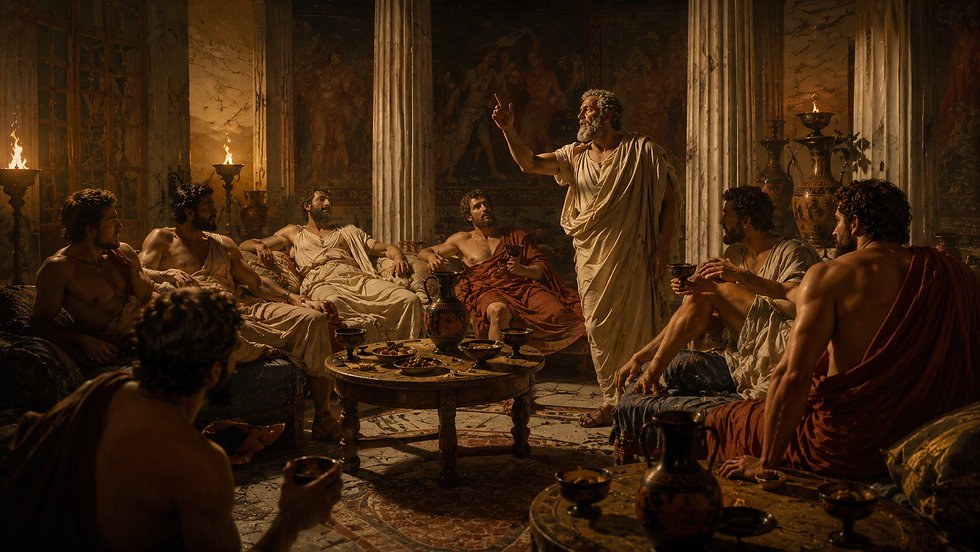
Ancient Greece had the symposium — a structured drinking gathering that was the primary venue for philosophical debate, political discussion, and the forging of social alliances. Plato's Symposium is literally set at a drinking party. The word symposium means, straightforwardly, "drinking together." Greek democracy was, in no small part, built around tables with wine.
The Norse had the blót — ritual feasting and drinking gatherings tied to religious observance, where mead (fermented honey) was consumed communally and oaths were sworn. The bond formed over shared mead was considered legally and spiritually binding.
Ancient China had elaborate wine ritual protocols — specific vessels, specific pouring sequences, specific toasting formulas — that governed diplomacy, alliance formation, and the marking of significant social transitions. To drink with someone was to enter a relationship of mutual obligation.
Ancient India had Soma — a sacred ritual drink described throughout the Rig Veda as the drink of the gods, consumed in religious ceremonies to create transcendent shared experience and community cohesion. (The precise identity of Soma remains debated — it may have been fermented, psychedelic, or both.)
Mesopotamia had temple breweries that produced beer for daily religious ritual — the gods were offered beer before humans consumed it, weaving fermented drink into the very fabric of sacred community life.
The pattern across every major ancient civilisation is consistent: alcohol was the social lubricant that made large-scale cooperation between strangers possible. Not because people were drunk all the time — the alcohol content of ancient beverages was low, and the quantities consumed daily were distributed throughout the day — but because the ritual of shared drinking was a powerful, reliable technology for generating the trust, cohesion, and mutual recognition that cities require.
From Ancient Brew to Modern Glass: The Alarming Evolution of Strength
Here is where the story takes a significant turn — and where the benevolent historical narrative starts to crack.
Ancient fermented beverages and modern alcoholic drinks share a name and a molecule. In almost every other respect, they are radically different products.
Ancient beer (Mesopotamia, Egypt, ~3,000 BC)
Alcohol content: 1–3%
Consistency: thick, grain-heavy, almost porridge-like in some versions
Consumed throughout the day in relatively constant small amounts
Nutritionally dense — rich in carbohydrates, B vitamins, some protein
Often consumed through straws to filter out grain sediment
Warm, unrefrigerated, relatively quickly consumed after production
Ancient wine (Greece, Rome, ~500 BC)
Alcohol content: 5–7%
Almost always diluted with water before drinking — typically 1 part wine to 2–3 parts water
Consuming undiluted wine was considered barbaric and associated with degeneracy
The Greek word for drinking undiluted wine — akratopotein — was used as an insult
Medieval ale and wine (~1000–1500 AD)
Ale: 2–4%, consumed primarily as safe hydration
Wine: 8–12%, increasingly traded as a luxury and status good
Spirits: essentially absent from mainstream consumption
Distillation changes everything (~9th century AD) The invention of distillation — credited to Arab alchemists in the Islamic world, with particular development by figures like Al-Kindi and later Paracelsus in Europe — created something qualitatively new: concentrated alcohol. Distilled spirits began appearing in European markets from approximately the 13th century onward.
Modern alcoholic beverages (20th–21st century)
Beer: 4–6% (standard), up to 20%+ for craft extremes
Wine: 12–15% (standard), up to 22% for some dessert wines
Spirits (whisky, vodka, gin, rum): 37.5–60% alcohol
Craft cocktails: frequently combine multiple high-alcohol spirits
The contrast is stark:
Era | Typical Drink | Alcohol % | Daily Role |
Ancient Mesopotamia | Barley beer | 1–2% | Primary hydration, nutrition |
Classical Greece | Diluted wine | 2–3% effective | Social ritual, symposium |
Medieval Europe | Small beer | 1–2% | Daily beverage, safe water sub |
19th century | Wine, beer | 5–10% | Social, medicinal |
Modern era | Spirits, cocktails | 15–60% | Recreational, stress relief |
The human brain that evolved to handle 1–2% fermented grain water consumed gradually throughout the day is now being presented with 40% distilled spirits consumed rapidly in social or stress contexts. The biology hasn't changed. The product has been transformed beyond recognition.
This is not a trivial distinction. It is arguably the central driver of alcohol's transition from civilisational tool to public health crisis.
Alcohol and the Brain: Why a Poison Feels Like a Gift

Let's get into the biology — because understanding what alcohol actually does to your brain makes the entire evolutionary story make sense.
The Neuroscience in Brief
Alcohol is what pharmacologists call a CNS depressant — it slows down central nervous system activity. But its effects are paradoxical, because the initial stages of intoxication often feel stimulating and energising. How?
The answer lies in what alcohol depresses first.
The brain has both excitatory neurons (that activate things) and inhibitory neurons (that dampen things). Alcohol's early effect is to depress inhibitory control systems — particularly the prefrontal cortex, which is responsible for self-monitoring, social anxiety, fear of judgment, and impulse control.
So the first effect of alcohol is not stupidity — it is the temporary quieting of the brain's self-critical, socially-anxious, risk-calculating systems. What remains, briefly, is a more uninhibited, socially open, less-fearful version of yourself.
This is why alcohol feels, at low doses, like a social superpower. Because for a species that spent millions of years in small, intensely judgmental social groups where saying the wrong thing could get you exiled, the ability to temporarily turn down the social anxiety dial has enormous practical value.
The Key Neurochemicals
GABA (gamma-aminobutyric acid): Alcohol enhances GABA activity — the brain's primary inhibitory neurotransmitter. This produces the calming, anxiety-reducing effects.
Glutamate: Alcohol suppresses glutamate — the brain's primary excitatory neurotransmitter. This produces cognitive slowing, memory impairment, and at high doses, the blackout.
Dopamine: Alcohol triggers dopamine release in the nucleus accumbens — the brain's reward centre. This is the "this is nice, let's do it again" signal, and the foundation of alcohol's addictive potential.
Endorphins: Alcohol triggers endorphin release — the same molecules released during laughter, physical exercise, and social bonding. This creates genuine feelings of warmth and connection.
Serotonin: Alcohol temporarily increases serotonin activity, producing mood elevation. With heavy or chronic use, this system becomes dysregulated — one reason why chronic heavy drinkers often experience depression.
Why the Brain "Allows" It: The Evolutionary Logic
The brain does not "want" alcohol in any straightforward sense. What the brain wants — desperately, evolutionarily — is:
Reduced social anxiety
Feelings of belonging and trust
Reward and pleasure signals
Caloric intake
Alcohol, at low doses in the environment it originally appeared in (weak beer, consumed gradually, in social contexts), delivered all four simultaneously. From an evolutionary standpoint, in the environment of ancient human groups, these were genuine survival advantages.
The tragedy is that the brain's reward systems were calibrated for 2% barley beer shared around a fire, not double whisky consumed alone on a Friday night. The same systems respond to both — but with dramatically different consequences.
The Animal Kingdom's Accidental Pharmacologists
Nature, it turns out, has been running alcohol experiments for millions of years:
Bohemian waxwing birds in Scandinavia routinely eat fermented rowan berries and become visibly intoxicated — stumbling, unable to fly straight, occasionally colliding with windows. Conservation agencies have actually issued public advisories about this phenomenon.
Moose in Sweden are annually reported raiding apple orchards to eat fermenting fallen apples, becoming intoxicated, and occasionally getting stuck in trees. (Swedish media covers this with the weary affection of a nation that has come to expect it.)
Australian wallabies have been found eating fermented poppies in Tasmania and then running in circles — which sounds like a wildlife documentary that got slightly off-track.
Vervet monkeys in St. Kitts, descended from populations brought from West Africa in the 1600s and having had 400 years of exposure to sugarcane and rum production, have developed what appears to be culturally transmitted alcohol preference. Young vervets copy the drinking behaviours of adults. Some are teetotallers. Some are binge drinkers. The population distribution of drinking patterns maps remarkably closely to human populations.
What these animal examples illustrate is that alcohol's effects on brain reward systems are not uniquely human — they are a feature of vertebrate neurology in general. The dopamine and endorphin systems that alcohol hijacks are ancient, conserved systems. We are not unusual in finding alcohol's effects rewarding. We are unusual only in the elaborate civilisational structures we've built around that reward.
Alcohol & Modern Society: When the Medicine Becomes the Disease
The story of alcohol is, in many ways, a story of a tool that outgrew its original context. What began as a solution to specific, acute problems — unsafe water, the need for social cohesion, caloric supplementation — persists into a world where those problems no longer exist, but the neurological wiring that made alcohol compelling absolutely does.

How Different Cultures Use Alcohol Today
France and Mediterranean Europe: Alcohol — primarily wine — is deeply embedded in meal culture. Consumption is typically moderate, food-accompanied, and social. France has relatively high per-capita alcohol consumption but significantly lower alcohol-related disorder rates than countries with similar consumption levels, likely due to cultural norms around how it is consumed.
Nordic Countries: Historically, the Nordic relationship with alcohol has been characterised by pattern drinking — relative abstinence during the week, significant binge drinking on weekends. This cultural pattern produces different health outcomes than the same total volume consumed daily in smaller amounts.
Japan: Sake and beer are deeply embedded in Japanese corporate and social culture. The nomikai (drinking party) is a near-mandatory social ritual in Japanese workplaces, used explicitly to dissolve workplace hierarchy and enable candid communication — a modern continuation of alcohol's ancient role as a social leveller.
India: India presents a fascinating paradox. It has one of the lowest per-capita alcohol consumption rates in the world, partly due to religious and cultural norms, yet has some of the highest rates of alcohol use disorder among those who do drink. This paradox — abstinence culture combined with problematic drinking patterns when abstinence breaks — is well documented in public health literature.
Islamic societies: The Quran's prohibition of alcohol (khamr) represents one of the most significant large-scale attempts in history to remove alcohol from a civilisational context. It largely succeeded — alcohol consumption in majority-Muslim countries is among the world's lowest. Yet the prohibition also created a black market, and studies suggest alcohol problems are underreported rather than absent.
United States: American alcohol culture is characterised by extremes — significant abstinence rates alongside significant heavy use, a history of dramatic prohibition (1920–1933) that demonstrably failed, and a craft beverage industry that has in recent decades reframed alcohol consumption as artisanal and sophisticated.
The Numbers Don't Lie
Let's be honest about what alcohol costs the modern world:
Global consumption:
Approximately 2.4 billion people currently consume alcohol globally (WHO, 2023)
Global alcohol consumption is approximately 6.4 litres of pure alcohol per person per year among the total adult population
Among drinkers only, average consumption is approximately 17 litres of pure alcohol per year
Health impact:
Alcohol causes approximately 3 million deaths per year globally — roughly 5.3% of all deaths (WHO)
It is a direct cause of over 200 disease and injury conditions
Classified as a Group 1 carcinogen — directly linked to cancers of the mouth, throat, oesophagus, liver, colon, and breast
Responsible for approximately 5.1% of the global burden of disease
Dependence and disorder:
Approximately 283 million people globally have an alcohol use disorder (WHO)
In India specifically, alcohol use disorder affects an estimated 10–11% of the adult male population
Alcohol is the third leading risk factor for premature death and disability globally
Economic cost:
In the United States alone, excessive alcohol use costs approximately $249 billion per year in lost productivity, healthcare, crime, and accidents
In India, alcohol-related economic losses are estimated at approximately 1.45% of GDP annually
Road safety:
Alcohol is involved in approximately 20–30% of all road traffic deaths globally
In India, drunk driving accounts for approximately 4–5% of road fatalities — likely an undercount given reporting challenges
Why It's Different Now
The ancient context for alcohol consumption involved several moderating factors that are largely absent today:
Low concentration. Ancient beer was 1–3% alcohol. Modern spirits are 40%+. The same behavioural pattern produces radically different blood alcohol levels.
Food integration. Ancient alcohol was consumed as food — thick, nutritive, grain-based. Modern alcohol is frequently consumed separately from food, accelerating absorption.
Social structure. Ancient drinking occurred in communal, structured ritual contexts with strong social norms around behaviour. Modern drinking frequently occurs in isolation, in high-stress contexts, or in competitive social environments that incentivise excess.
The problem is no longer the solution. Safe water is universally (or near-universally) available. The fundamental civilisational problem that alcohol solved — hydration safety — no longer exists in most of the world. The tool persists without its original purpose.
Stress and self-medication. Modern alcohol use is heavily driven by stress, anxiety, and sleep problems — all conditions for which alcohol provides short-term relief and long-term deterioration. The evening glass of wine after office (yes, I see you, I've been there) is a fundamentally different use case than communal ritual drinking in ancient Mesopotamia. And the brain's reward systems cannot tell the difference.
As I've explored in my blog on the real science of weight and food after 40, the body's metabolic responses to what we consume are far more nuanced than we typically assume — and alcohol is arguably the clearest example of a substance where the gap between "feels fine" and "actually fine" is largest and most dangerous.
The Future of Dopamine: Humanity's Endless Search for the Off Switch

Here is the deepest question this entire exploration raises: is this about alcohol at all?
Or is it about something more fundamental — the human brain's ancient, insatiable need to occasionally turn down the volume?
The Universal Pattern
Look across human history and you find the same pattern, endlessly repeated, across every culture and every era:
Humans seek substances and experiences that temporarily modify consciousness. Not all humans. Not always. But persistently, cross-culturally, and with remarkable consistency.
Where alcohol was unavailable, kava filled the role
Where kava wasn't available, coca did
Where coca wasn't available, betel nut did
Where none of these were available, ritual fasting, drumming, dancing, and other altered-state practices filled the same psychological function
The anthropologist and neuroscientist Andrew Weil, writing in the 1970s, proposed what he called the "Stoned Ape" principle — the idea that the desire to alter consciousness is a fundamental, universal human drive, as basic as the drives for food, sex, or social connection. More recent evolutionary psychology has taken this idea seriously, with researchers like Edward Slingerland arguing that the human need to occasionally "turn off" the hyperactive, self-monitoring, socially anxious prefrontal cortex is a genuine adaptive requirement for social animals under constant cognitive load.
The prefrontal cortex — our unique, extraordinarily powerful capacity for planning, self-monitoring, abstract thought, and social calculation — is also, it turns out, exhausting. It generates anxiety, rumination, social fear, and the peculiarly human torment of overthinking. The desire to occasionally silence it is not weakness or moral failing. It is, apparently, neurologically hardwired.
What Comes Next
The future of this phenomenon is already visible:
Cannabis legalisation is spreading globally, and there is significant evidence that legal, regulated cannabis is beginning to substitute for alcohol in some demographic groups — particularly younger adults who are drinking less but not necessarily abstaining from all consciousness alteration.
Psychedelic-assisted therapy — psilocybin, MDMA, ketamine — is moving rapidly from fringe to mainstream clinical acceptance, with FDA-approved protocols now in sight. These substances are being studied not for recreational use but for therapeutic interruption of rumination, depression, PTSD, and addiction. The irony that some of humanity's oldest ritual substances are becoming its newest psychiatric medicines is not lost on historians.
Non-alcoholic "functional" beverages — drinks containing adaptogens, nootropics, or low-dose cannabis compounds that produce mild relaxation without intoxication — are among the fastest-growing categories in the beverage industry. The ancient function (communal, calming, socially shared) without the ancient cost.
Digital dopamine — social media, gaming, streaming — represents a non-chemical but neurologically equivalent form of reward-system hijacking. The same endorphin and dopamine circuits that alcohol activates are activated by a notification, a "like", or another episode autoplay. We have, in some sense, industrialised dopamine manipulation at a scale that would have astonished ancient brewers.
The question for the next century is not whether humans will continue seeking to occasionally modify their consciousness — they will, they always have, it appears to be structural. The question is whether we can design better tools: substances or practices that deliver the genuine social, psychological, and neurological benefits that alcohol has historically provided, without the liver damage, addiction, cancer risk, and the 3 million annual deaths.
That is a project worth working on.
As I explored in my post on mindfulness techniques for stress and modern life, some of the most powerful tools for managing the very anxiety and cognitive overload that alcohol temporarily relieves are freely available, non-toxic, and neurologically well-supported. The prefrontal cortex can be quieted without poisoning the liver. It just requires more patience.
Closing: A Complicated Toast to a Complicated Molecule
I started this exploration hating alcohol. I won't say I've ended loving it — the public health statistics make that a difficult position to hold. But I have ended it understanding it differently.
This molecule — two carbon atoms, one oxygen atom, a handful of hydrogens — has been with humanity for a very long time. It helped us survive unsafe water. It helped us build the trust that cities require. It may have inspired us to farm. It funded the labour that built the pyramids. It arguably provoked the invention of writing. It powered the philosophical gatherings where democracy was debated and science was born.
It has also destroyed livers, broken families, killed drivers, and created dependence in hundreds of millions of people.
Both of these things are true simultaneously. And perhaps the most honest thing we can say about alcohol is that it was a brilliant solution to a set of ancient problems that no longer exist — running on hardware (the human brain) that hasn't been updated to reflect the fact that the problems have been solved.
The ancient Mesopotamian worker who drank 4 litres of 1.5% barley beer a day was making a rational choice. The modern professional who reaches for a double whisky after a stressful meeting is running the same software on a very different problem.
Understanding that distinction — really understanding it, in the bone — seems like a reasonable place to start.
I read "Drunk" over three evenings. I had water.
Further Reading
If this topic has sparked your curiosity, these books go deeper into the themes explored here:
Drunk: How We Sipped, Danced, and Stumbled Our Way to Civilisation — Edward Slingerland (2021). The primary source for this blog. Rigorous, funny, and genuinely mind-changing.
Sapiens: A Brief History of Humankind — Yuval Noah Harari (2011). The broader story of how shared fictions and social technologies built human civilisation — essential context for the alcohol story.
The Omnivore's Dilemma — Michael Pollan (2006). How human relationships with specific plants and substances shaped both civilisation and biology. Pollan's subsequent work on psychedelics (How to Change Your Mind) is also directly relevant.
How to Change Your Mind — Michael Pollan (2018). The history and neuroscience of psychedelics — the road not taken by mainstream civilisation, now being revisited with urgency.
The Botany of Desire — Michael Pollan (2001). How four plants — including cannabis — co-evolved with human desire. A fascinating parallel to the alcohol story.
Stealing Fire — Steven Kotler & Jamie Wheal (2017). How humans across history have sought altered states — from ancient ritual to modern neuroscience — and what this means for the future.
This Naked Mind — Annie Grace (2018). A clear-eyed, compassionate examination of the modern psychology of alcohol — highly recommended if this blog has prompted any personal reflection.
Also from this blog — if you found this exploration interesting, you might enjoy:
My 2025 Reading Wrap-Up: 22 books that shaped my thinking — including several titles that overlap with the themes explored here
12 Must-Read Books to Transform Your Health & Life — if the health science dimension of this blog resonated
Not All Calories Are Equal: The Real Science of Weight, Food & Energy After 40 — the body's relationship with what we consume is always more complex than we assume
Simple Meditation Techniques to Reduce Stress — the alcohol-free way to quiet the prefrontal cortex
Happy Reading.
⚠️ Final Note: Alcohol is a WHO Group 1 carcinogen directly linked to cancers of the mouth, throat, liver, bowel, and breast — with no established safe consumption level. It causes ~3 million deaths annually. Cannabis, psychedelics, opioids, and other substances discussed in this blog carry their own serious health, dependency, and legal risks. Nothing here is a reason to consume any of them. The author is not a doctor. If you or someone you know needs support with substance use, please consult a qualified medical professional.


Comments