Lesser Known Facts: India's Independence Day

15th August, 1947: The Lesser Known Facts About Independence Day Nobody Taught Us
Before We Talk About 15th August
I studied in Sainik School Balachadi. Every year, weeks before 15th August, we would start practicing for the Independence Day Parade. Shoes polished every day. Belt and buckle shining. If even one cadet's hand or foot was out of sync during drill, the whole group got punished for it.
The day itself was a big deal. The Chief Guest was usually a senior Armed Forces officer, and we actually listened to his speech. There was hi-tea, then Bada Khana in the evening. Patriotic songs played on the PA system the whole day. You felt proud. You felt part of something.
Now, in Bangalore, 15th August looks different.
In apartment buildings, there's a flag hoisting around 9 am. A few kids sing, someone dances, there's usually a skit put together the night before. People show up in white kurtas.
In offices, the celebration starts a day earlier. You walk in and the place is decorated. Flags, balloons in white, green and orange, taped to every pillar. Some games in the evening. Sometimes a special lunch.
And there is a new class of people who check the calendar in January itself to see if the I-Day is on a weekday or a weekend! Because if 15th August falls on a weekend, they lose a holiday. And with it, the long weekend they had planned since January, to Coorg or Chikmagalur or Wayanad. That one hurts.
Somewhere between the boot polish years and the balloon years, I started reading a few books about that time, 1947 and the years around it. And I found some stories most of us never learned in school. Small ones. Odd ones. The kind that make you pause.
So here they are, roughly in the order they happened. Not instead of what we already know about our freedom struggle. Just a few extra things worth knowing.
Independence didn't come cheap
Before anything else, one thing needs to be said clearly.
Bhagat Singh, Rajguru and Sukhdev were hanged together in 1931. Chandrashekhar Azad shot himself rather than get caught, at the age of 24. Udham Singh waited 21 years to avenge Jallianwala Bagh, and finally did it in London in 1940. Thousands of others, whose names we don't even know, were jailed, flogged, or killed. That is the real backbone of our independence. Nothing in this piece takes away from that.
But alongside all of this, there were two events, less spoken about, that also pushed Britain to leave faster than planned.
The trial that backfired
After the 2nd World War, the British put captured soldiers of the Indian National Army, the force raised by Subhas Chandra Bose, on public trial at the Red Fort. The idea was to show Indians that these men were traitors.
It backfired completely. The first three men in the dock were a Hindu, a Muslim and a Sikh, tried together. People didn't see traitors. They saw heroes. Protests broke out across the country.

The mutiny that shook the empire
In February 1946, sailors of the Royal Indian Navy, over 20,000 of them across 78 ships, refused to follow orders. They hoisted the tricolour on Royal Navy ships.
This was not the national flag we know today. That came later, in July 1947. What the sailors hoisted was the flag of the Indian National Congress, adopted in 1931. Saffron, white and green, with a spinning wheel in the centre instead of the Ashoka Chakra. It had already been the flag of the freedom movement for 15 years by then. Designed originally by Pingali Venkayya, it was the closest thing India had to a national flag, even though the country itself didn't exist yet. So when the sailors raised it, they weren't waiting for an official flag to rebel under. They just used the one the movement had already made its own.
For four days, the British genuinely did not know if they could rely on their own armed forces in India anymore.
Years later, in 1956, the British Prime Minister Clement Attlee visited India. Someone asked him directly, why did the British leave in such a hurry, when Gandhiji's movement had mostly settled down by then. Attlee's answer was blunt. It was the INA and the Naval Mutiny, not the mass movement, that convinced Britain they could no longer trust the Indian Army and Navy to hold the country for them.
So here's the twist. Even after giving up India, the British still managed to make it sound like leaving was their idea. Not the freedom fighters. Not the sailors. Just Britain, being reasonable, right on schedule.

Two men from the same corner of Gujarat
Gandhiji and Jinnah ended up on opposite sides of history. But they started in almost the same place.
Gandhiji was born in Porbandar, on the Kathiawar coast of Gujarat, in 1869. Jinnah wasn't born in Gujarat himself, he was born in Karachi. But his family was. His grandfather was from a village called Paneli, in Gondal state, also in Kathiawar. The family belonged to the Lohana community, Gujarati Hindu traders, before they converted to Islam. Gandhiji's own family, the Modh Banias, were also Gujarati Hindu traders. Two men who changed the map of the subcontinent, and their family homes are barely 150 km apart, in the same corner of the same peninsula.
There's a personal connection here for me too. I'm from Rajkot, in the same Kathiawar region, and Gondal is practically next door to it. My father taught for years at Alfred High School in Rajkot, the same school Gandhiji studied in. Gandhiji passed out in 1887. My father joined in the 1990s.
And since we're talking about Gandhiji and Gujarat, here's one for you. Gujarat has had prohibition since 1960, out of respect for Gandhiji's principles. So the next time you're in Ahmedabad or Rajkot and it takes you a little longer than expected to find a drink (through permit), you know who to thank. <Wink Wink>

The plan that almost split India into pieces
Mountbatten's first plan, in May 1947, would have let every province and princely state in India choose for itself. Join India, join Pakistan, or stay independent. Nehru rejected it immediately. He said it would break the country into dozens of small pieces instead of two. The plan was scrapped before anyone outside a small circle even saw it.
The revised version came on 3 June 1947. Partition, two countries, princely states had to join one or the other, no more standing alone. Nehru, Jinnah, Patel and Sikh leader Baldev Singh all sat at the same table and agreed to it. Ten weeks later, India would be free.
Here's one of the more overlooked lesser known facts about Independence Day — how close the whole plan came to falling apart before it even started.
Mountbatten wanted to be Governor-General of both countries
Before India and Pakistan even had separate governments, Mountbatten proposed something unusual. He wanted to be the shared Governor-General for both new countries. Nehru was fine with it.
Jinnah said no. He made himself Pakistan's first Governor-General instead.
Some Pakistani historians believe this personally upset Mountbatten, and that it shaped how the Radcliffe line was eventually drawn, with contested areas like Ferozepur and Gurdaspur going to India instead of Pakistan. This is a genuinely disputed claim. Indian and British accounts don't support the idea that Mountbatten influenced the boundary out of personal offence, and Radcliffe always maintained his decisions were independent. Worth knowing the theory exists, but it's one side's version of events, not settled history.
The richest man in the world said no to India
The Nizam of Hyderabad, Mir Osman Ali Khan, was not just a ruler with big ambitions. In 1937, Time magazine put him on its cover and called him the richest man in the world. His fortune came largely from the Golconda diamond mines. He used a 185 carat diamond, worth tens of millions of dollars even then, as a paperweight on his desk. Hyderabad had its own army, its own railway, even its own currency.
So when the June 3 Plan said every princely state had to join India or Pakistan, the Nizam simply said no to both. On 15 August 1947, the same day India became independent, he declared Hyderabad an independent country.
Sardar Patel was having none of it. He called Hyderabad a cancer in the belly of India, sitting right in the middle of the country while claiming to be its own nation. Negotiations dragged on for a year, while a militia loyal to the Nizam called the Razakars carried out violence against Hyderabad's Hindu population. Patel had had enough.
On 13 September 1948, the Indian Army marched in. The operation was called Operation Polo, named after the Nizam's favourite sport. It took five days. The Nizam surrendered on 17 September, and Hyderabad became part of India.
This is not just an old story. Hyderabad state at the time covered what is today Telangana, along with parts of present day Karnataka and Maharashtra. Every year, 17 September is still marked as Hyderabad Liberation Day in that region, and it remains a genuinely debated and sensitive date even now, especially around how the transition and its aftermath are remembered.

A line drawn by a man who never saw the land he was dividing
Cyril Radcliffe arrived in India in July 1947 and left five weeks later, having never set foot in the country before. He had five weeks to draw a border that would divide Punjab and Bengal, using outdated maps and old census data, in a country whose language, geography and communities he did not understand. He wasn't even a geographer. He was a lawyer.
The line he drew split villages down the middle. It put some families on one side of a border and their farmland on the other, overnight. It divided rivers, railway lines, and in some cases, single homes.
When the line was finally published on 17 August, two days after independence, people had already become citizens of a country whose exact shape they didn't know yet. What followed was one of the largest human migrations in history. Somewhere between 10 and 14 million people crossed the new border in both directions. Estimates of how many died in the violence that followed vary wildly, from around 200,000 to well over a million, and historians still argue about the real number.
Radcliffe refused to take his fee for the work. He burned all his papers and left India the day after independence, never to return. He said later he didn't want eighty million people with a grievance finding him.
And the story doesn't end there. The two halves of Pakistan that Radcliffe's line created, separated by over a thousand miles of Indian territory in between, never really functioned as one country. In 1971, East Pakistan broke away after a brutal war, and became Bangladesh. So in a very real sense, one man's five weeks of guesswork eventually gave us three countries instead of two, and a human cost that's still being counted.

Gandhiji and the flag he refused to salute
On 22 July 1947, the new Indian flag was shown to the Constituent Assembly. The spinning wheel, the charkha, that had been on the flag since the freedom movement started, was replaced with the Ashoka Chakra.
Gandhiji was hurt by this. On 6 August, he said plainly, if the flag doesn't have the charkha on it, he wouldn't salute it. Nehru's reasoning was practical, the spinning wheel couldn't be printed the same on both sides of the cloth. But for Gandhiji, it was bigger than printing. The charkha stood for his entire vision of self-reliant villages. Its removal marked the country choosing a different path, industrial and centralised, instead of his.

The dying man who couldn't wait
By 1947, Muhammad Ali Jinnah was seriously ill. He had tuberculosis and lung cancer. Almost nobody knew. Not the British, not Indian intelligence, not even most of his own party. His sister Fatima kept his X-rays locked away with a doctor in Bombay.
Jinnah pushed hard for speed through all the negotiations. "Whatever is to be done, do it quickly," he kept saying. Many historians now believe part of that urgency came from a man racing against his own body.
At his independence banquet on 13 August 1947, he could barely speak. He asked Mountbatten if he could leave early, saying he felt close to collapse. He died thirteen months later.
Mountbatten said years afterward that if he had known how sick Jinnah really was, he probably would have stalled the whole process and tried harder to keep India united. One medical secret, kept from almost everyone, may have shaped how the map of South Asia turned out.

Why independence happened at midnight, not morning
When Mountbatten announced 15 August as the date, Indian astrologers were not happy. The date fell on Chaturdashi, with an inauspicious new moon, considered one of the worst combinations on the calendar. Rajendra Prasad, who would go on to become India's first President, was warned directly about it.
The fix was simple once someone thought of it. The Hindu calendar starts a new day at sunrise, not midnight. So the ceremony was set for the stroke of midnight between 14 and 15 August. By the Western calendar, independence happened on the 15th. By the Hindu calendar, it was still the 14th. Everyone got the date they needed.
Two independence days, one midnight
That same midnight ceremony is also why Pakistan celebrates its independence a day earlier than India. Mountbatten went to Karachi first, then Delhi. Pakistan's transfer of power technically happened before India's, so Pakistan marks 14 August. Same event, same midnight, two different calendars.
The flag that beat Delhi to it
While Delhi is remembered as the place independence happened, a small ceremony at Fort St George in Madras raised its flag at 5.30 in the morning on 15 August, hours before anything happened in the capital. That flag still exists today, kept in a museum at the fort. A fair case exists that it was actually the first flag raised in independent India.
Gandhiji didn't celebrate
While Delhi celebrated through the night, Gandhiji was in Calcutta. He wasn't marking independence at all. He was fasting, trying to stop Hindu-Muslim riots that had broken out in Bengal. He didn't attend a single independence ceremony anywhere.

Nehru's famous speech, on the wrong day
Most people picture Nehru raising the flag at Red Fort at the stroke of midnight on 15 August. That's not quite right. According to Nehru's own archives, his Red Fort speech, titled "The Honour of the Flag," is dated 16 August, a full day after the midnight ceremony everyone remembers.

A country with no capital, no factories, and no money to start with
Pakistan came into being on 15 August 1947 with almost nothing to run itself. Cotton and jute were grown on its land, but the mills that turned them into cloth and rope were all on India's side of the border, in Bombay and Calcutta. Agriculture made up more than half its economy at birth, and there was barely any industry to speak of.
Even its capital was a fallback option. Lahore, the obvious choice, was too close to the new border to feel safe. So Karachi, which had no real machinery of government built for the job, became the capital by default.
Gandhiji's last big fight, over money
At partition, India's cash reserves with the Reserve Bank stood at around Rs 375 crore. Pakistan's agreed share of that was Rs 75 crore. India paid Rs 20 crore immediately in August 1947. The remaining Rs 55 crore was withheld the moment Pakistan invaded Kashmir that October.
Gandhiji insisted the money be paid anyway. His argument was simple: an agreement is an agreement, and a war doesn't cancel a debt that was settled before the war started. The government listened. The Rs 55 crore was released on 15 January 1948. Two weeks later, Gandhiji was assassinated.
Independent, but still under the King
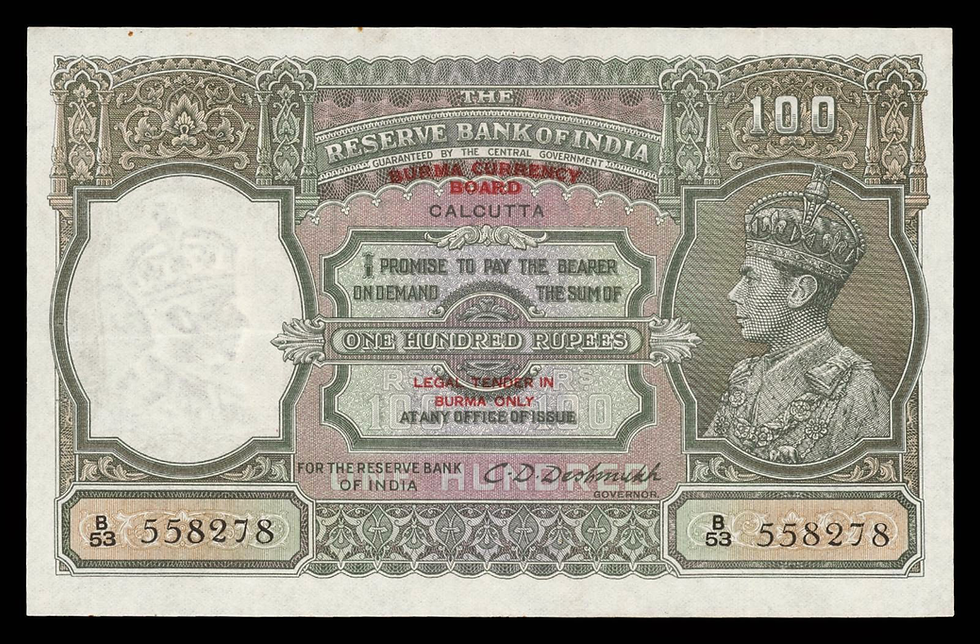
15 August 1947 didn't actually make India fully sovereign. India became a Dominion, which meant King George VI remained head of state, and Mountbatten, followed by Rajagopalachari, governed as his representative. The country still ran under a law framed by the British, the Government of India Act of 1935. This lasted until 26 January 1950, when India's own Constitution came into force and the country became a republic. For two and a half years, independent India still had a British king on its coins.
What we almost called ourselves
In 1949, when the Constituent Assembly sat down to write Article 1 of the Constitution, the name of the country was actually up for debate. Members proposed Bharat, Hindustan, Hind, Bharatbhoomi, Bharatvarsha, and Aryavrat. Ambedkar's compromise line made it into the final text: "India, that is Bharat, shall be a Union of States." That one sentence is why we still use both names today.
The last piece of the map
Goa did not become part of India in 1947. It stayed under Portuguese rule for another fourteen years, until the Indian Army moved in and annexed it in December 1961.

You couldn't legally fly your own flag until 2002
For over fifty years after independence, ordinary citizens were not allowed to fly the national flag on their own homes or offices. It was restricted mostly to government use.
That changed only after businessman Naveen Jindal took the matter to the Supreme Court, and the flag code was amended in 2002 to let every Indian fly the tricolour freely.
Where we stand now
That's the story of how we got here. Astrologers negotiating with a Viceroy. A lawyer who had never seen India drawing its borders in five weeks. A dying man racing against his own body. A country starting out as a Dominion, still not fully its own. All of it messier, stranger, and more human than the version we learned in school.
Look at where we started. A country freshly broken into pieces, poor, short of food, short of factories, with millions displaced overnight and no real government machinery of its own to speak of. Nobody outside India gave it much of a chance back then.
Look at where we are now. A country that built its own institutions from scratch, that feeds itself, that runs elections at a scale nobody else attempts, that sends people into the corner offices of companies all over the world. None of this happened on its own. It took the freedom fighters who paid with their lives before 1947, and it took the leaders and ordinary people who kept building, one decade at a time, after it.
We still have real distance to cover. Poverty hasn't gone away. Too many of our own people still don't get a fair shot at education, healthcare, or opportunity. Institutions that should be strong are still finding their footing. None of that is small, and none of it should be brushed aside just because the flag is flying.
But that's exactly the work ahead. The freedom we got in 1947 was the starting point, not the finish line. What we do with it from here is still very much up to us.
Jai Hind.
Further Reading
1. Freedom at Midnight by Larry Collins and Dominique Lapierre Get your copy
A blow-by-blow account of the final months before independence, built from interviews with almost everyone who was in the room, including Mountbatten himself. Several of the stories in this piece, the astrology fix, Jinnah's illness, Radcliffe's five weeks, trace back to this book. If you read one book on 1947, this is probably it.
2. Indian Summer: The Secret History of the End of an Empire by Alex von Tunzelmann Get your copy
A more personal, character-driven take on the same period, with a sharper focus on the relationships between Mountbatten, Edwina, and Nehru. Good companion to Freedom at Midnight, covers the same ground with a different lens and a lot more on the personalities involved.
3. India After Gandhi by Ramachandra Guha Get your copy
The story of India from 1947 onward, how the country actually held together and built its institutions in the decades after independence. Picks up exactly where this piece ends, useful if the "where we are now" section made you want the fuller story.
4. The Great Partition: The Making of India and Pakistan by Yasmin Khan Get your copy
A history of Partition itself, told with a strong focus on the human cost and the migration, rather than the political negotiations. Goes deep into exactly the part this piece could only gesture at, the scale of displacement and loss that followed Radcliffe's line.
5. Midnight's Furies: The Deadly Legacy of India's Partition by Nisid Hajari Get your copy
Covers the violence of Partition and its long shadow on India-Pakistan relations ever since. Useful if you want to understand how directly the events of 1947 still shape the region today.
6. Jinnah of Pakistan by Stanley Wolpert Get your copy
A full biography of Jinnah, written with access to material that gives a more complete picture of the man than most Indian accounts offer. Good balance to a piece that, being India-focused, doesn't spend much time on Jinnah's own side of the story.
7. Patel: A Life by Rajmohan Gandhi Get your copy
Covers Patel's role in the integration of princely states in detail, including Hyderabad and the events of Operation Polo. Happy Reading!


Comments