Book Review - Artificial Intelligence: A Guide for Thinking Humans
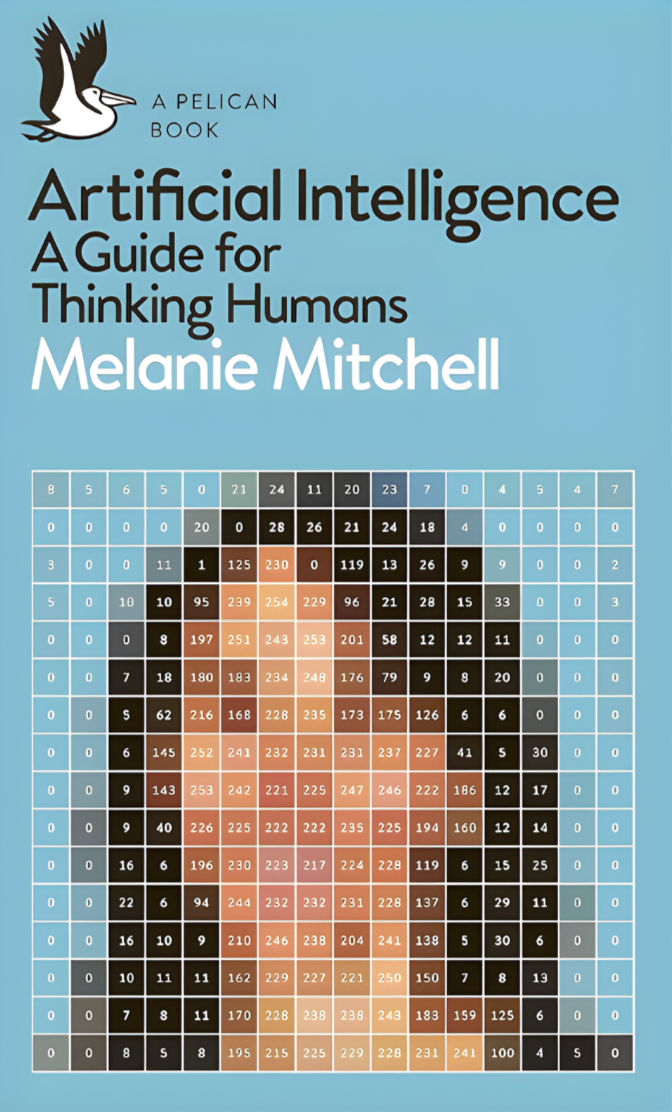
If you believe the headlines, Artificial Intelligence is either about to cure all known diseases by Tuesday or turn us into paperclips by Friday. It’s a polarized world of utopian abundance and dystopian dread. But if you actually work in the field, you know the reality is far messier, and often, far funnier.
Artificial Intelligence: A Guide for Thinking Humans by Melanie Mitchell is the antidote to that breathless hype. It is a grounding, lucid, and necessary reality check.
While Ray Kurzweil is predicting we will merge with machines in the 2030s (a fascinating vision I reviewed in The Singularity Is Nearer), Mitchell gently reminds us that our smartest AI still has trouble distinguishing a school bus from an ostrich if the lighting is weird. This book isn't about what AI might do in a sci-fi future; it's about what AI actually is right now, how it works, and why "human-level" intelligence is much harder to replicate than simply adding more processing power.
If you are tired of the noise and want the signal, this is your manual.
What is Artificial Intelligence: A Guide for Thinking Humans
This book is a comprehensive, accessible tour of the history, mechanics, and current limitations of AI, written by an actual computer scientist.
Melanie Mitchell, a professor at the Santa Fe Institute, takes a "thinking human's" approach to the subject. She peels back the layers of Deep Learning, neural networks, and computer vision without drowning the reader in math.
The central thesis is simple but profound: Intelligence is not just pattern matching. Current AI is spectacular at statistics but terrible at "meaning." Mitchell argues that until machines possess a fundamental understanding of the world, common sense, cause-and-effect, and physical laws, we are nowhere near General AI (AGI).
"We have to be careful not to mistake the map for the territory. AI has mastered the map of statistics, but it has yet to step foot in the territory of understanding." Paraphrased from Melanie Mitchell

Key Takeaways: The Barrier of Meaning
The biggest hurdle facing AI today is the 'Barrier of Meaning' - the inability of algorithms to understand the context of the data they process.
Here is the breakdown of Mitchell’s core arguments:
Narrow vs. General AI: We have mastered "Narrow AI" (AlphaGo beating humans at Go, Alexa setting timers). We have made almost zero progress on "General AI" (a machine that can learn any task like a human child). The gap between the two is not just a matter of "more data"; it requires a different architecture entirely.
The Fragility of Deep Learning: Mitchell highlights how brittle current AI systems are. Change a few pixels in an image, and a "superhuman" image classifier suddenly thinks a stop sign is a speed limit sign. This fragility is a massive risk for autonomous driving and healthcare.
The "Long Tail" Problem: Life is full of edge cases. Humans handle these with common sense. AI fails because it cannot train for every possible weird scenario (like a woman in a dinosaur costume crossing the street).
The fallacy of "Easy things are easy, hard things are hard": In AI, the opposite is often true. Calculus and chess (hard for humans) are easy for computers. Walking, folding laundry, and holding a conversation (easy for humans) are incredibly hard for computers.
This aligns perfectly with the concerns raised in Mustafa Suleyman’s work, which I discussed in my review of The Coming Wave. While Suleyman focuses on the containment of these technologies, Mitchell focuses on their inherent technical limitations.
The Writing Style: A Scientist Who Speaks Human
Melanie Mitchell writes with the clarity of a teacher and the wit of a skeptic, making complex technical concepts digestible for the layperson.
If you found The Singularity Is Near a bit too dense or theoretical, Mitchell’s style will be a breath of fresh air. She uses analogies that stick.
On Neural Networks: She compares them to a "bucket brigade" of information, demystifying the "black box" nature of how AI learns.
On AI Hype: She employs a wonderful, dry humor to poke holes in press releases that claim AI has "learned to read." (Spoiler: It hasn't. It's just finding statistical correlations in text.)
She strikes a tone that is authoritative yet humble. She loves the field of AI, which is exactly why she refuses to overhype it.
Comparing Visions of the Future
To understand where Mitchell fits in the landscape of AI literature, it helps to compare her "Pragmatic Realist" view with other dominant perspectives.
Perspective | Representative Book | Core Belief | Mitchell’s Counter-Point |
The Optimist | The Singularity is Nearer (Kurzweil) | Exponential growth will solve everything; AGI is imminent. | Computing power = Understanding. Hardware isn't the bottleneck; software architecture is. |
The Warning | The Coming Wave (Suleyman) | AI is a tsunami that requires immediate containment. | AI is powerful, but let's not anthropomorphize it. It breaks easily. |
The Abundance | The Great Un-Scarcity (My Post) | AI will drive the marginal cost of goods to zero. | Possible, but only if AI can navigate the messy, unstructured real world reliably. |

I explored the optimistic economic angle in my post The Great Un-Scarcity: Why Your Grandkids Won't Fight Over Apples. Mitchell’s book serves as a necessary technical constraint to that economic vision - we can get to abundance, but the engineering road is bumpier than the graphs suggest.
What This Means For Us in the Future
The future will not be dominated by "machines that think" in the human sense, but by "machines that calculate" alongside humans who understand context.
Mitchell concludes that we are unlikely to see true AGI anytime soon. This has two major implications for corporate professionals:
Job Augmentation, Not Replacement: Since AI lacks common sense and empathy, jobs requiring these traits are safe. The "human in the loop" is not a temporary fix; it’s a permanent necessity for the foreseeable future.
Skepticism as a Skill: When a vendor tries to sell you an AI solution that "understands" your customers, you can now confidently ask, "Does it understand, or does it just predict text?" The difference saves you millions.
Essential AI Terminology From the Book
Deep Learning: A type of machine learning based on artificial neural networks with multiple layers, used to model complex patterns in data.
Transfer Learning: The ability of an AI to apply knowledge learned in one domain (e.g., recognizing cats) to a new domain (e.g., recognizing dogs). Humans are great at this; AI is currently terrible at it.
Adversarial Examples: Inputs to a neural network (like an image with slightly modified pixels) that are intentionally designed to cause the network to make a mistake.
Conclusion
Artificial Intelligence: A Guide for Thinking Humans review boils down to one sentiment: Respect the complexity of your own mind.
Melanie Mitchell has written the definitive guide for anyone who wants to understand the mechanics behind the magic. She strips away the sci-fi veneer to reveal the nuts and bolts of machine learning - impressive, powerful, but ultimately limited.
It’s easy to get swept up in the narrative that we are on the verge of creating gods. Mitchell reminds us that we are still trying to build a machine that knows it shouldn't put a toaster in the bathtub.
So, are we heading toward the singularity? Maybe. But we might want to figure out how to make a robot fold a fitted sheet first.

Reflective Question: If AI can predict your next email word but doesn't know why you are sending the email, can we ever truly trust it with critical decisions?
Further Reading
If you want to dive deeper into the implications of AI, here is a curated list.
Recommended Books:
Life 3.0 by Max Tegmark – A physicist's view on the cosmic implications of AI.
Human Compatible by Stuart Russell – Focuses on the "control problem" and how to align AI with human values.
Superintelligence by Nick Bostrom – The philosophical deep dive into the risks of superintelligent agents.
Rebooting AI by Gary Marcus & Ernest Davis – A similar skeptic’s view to Mitchell, arguing for a return to symbolic AI.
From the Rathod M Library:
For a broader list of essential reading: 10 Must-Read Books on AI and Humanity's Future
For the counter-argument on speed and exponential growth: The Singularity Is Nearer Book Review
Happy Reading.


Comments